
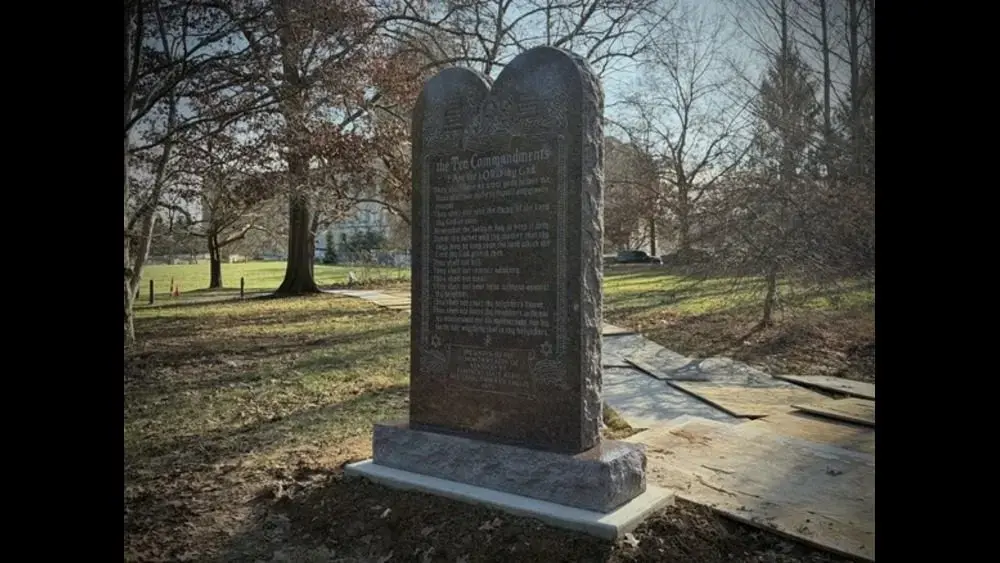
Originally removed for construction more than 30 years ago, and for other issues since, Kentucky Attorney General Russell Coleman is among many now celebrating the return of an historic “Ten Commandments” monument back to the Capitol grounds — which occurred this past Wednesday in Frankfort.
The move comes after efforts were pushed this past February, when Coleman published a formal Attorney General’s Opinion, and the Kentucky General Assembly passed House Joint Resolution 15 — ordering the monument’s return. It flew through the House 79-13 and then moved through the Senate 32-6, before the bill was delivered to the desk of Governor Andy Beshear.
According to a March 25 report from Don Byrd with the Baptist Joint Committee for Religious Liberty, dozens of faith leaders, some Christian, wrote and co-signed a letter to Beshear beseeching him to veto the law — citing it is the role of government to “respect the rights of individuals and faith communities to make decisions about the sacred texts that inform [our] religious understandings and practices,” and that “laws mandating the display of the Ten Commandments on government property demean that freedom.”
The letter went on to note that the text of this monument is not “universal or inclusive to all faith traditions,” nor does the monument’s version of the Ten Commandments exist in “any translation of the Bible,” and that its base mantras hold no religious meaning to thousands of Kentuckians practicing Muslim, Hindu, Buddhist, Sikh, Unitarian Universalist, perhaps some other religion — or maybe none at all.
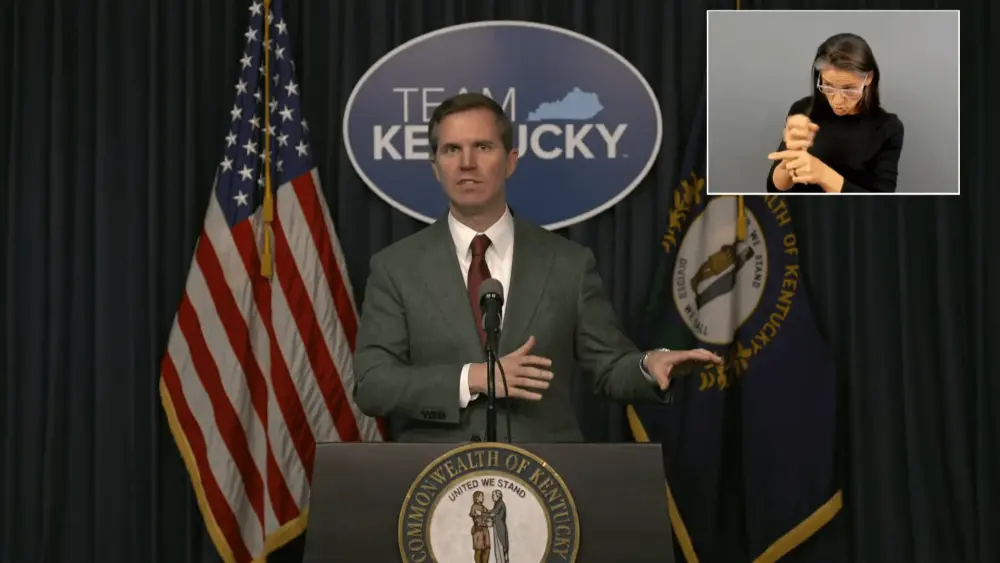
Rather than veto the bill, Beshear left it unsigned — where it then became law through the House and Senate.
Coleman’s opinion stated the Ten Commandments could be displayed in public school classrooms and the Capitol grounds without violating the First Amendment, despite other precedent, and in 2022, the U.S. Supreme Court overturned previous standards and paved the way for re-installation.
Coleman called the Ten Commandments “the heart of America’s history and founding,” and he said he was grateful for Kentucky legislators taking this important step to uphold history.
In December 2024, Coleman was part of an 18-state coalition supportive of a Louisiana law allowing for Ten Commandments displays in public classrooms.
Through the King James Version of the Christian Bible, the Ten Commandments can be found in the Old Testament chapters of Exodus and Deuteronomy. They serve as the foundation of Judeo-Christian ethics, and, in short, ask citizens to do the following:
1) You shall have no other gods before Me.
2) You shall not make for yourself a carved image.
3) You shall not take the name of the Lord your God in vain.
4) Remember the Sabbath day, to keep it holy.
5) Honor your father and your mother.
6) You shall not murder.
7) You shall not commit adultery.
8) You shall not steal.
9) You shall not bear false witness against your neighbor.
And 10) You shall not covet.
Per the American Civil Liberties Union, Kentucky’s history with the Ten Commandments is rather lengthy.
November 17, 1980 – Stone v. Graham: In a lawsuit brought by the ACLU of Kentucky, the U.S. Supreme Court rules that posting the Ten Commandments on classroom walls is unconstitutional, finding the display “plainly religious in nature.”
November 18, 1999: The ACLU of Kentucky files three lawsuits challenging the posting of the Ten Commandments in Harlan County public schools and in the McCreary and Pulaski County courthouses.
May 5, 2000 – ACLU v. McCreary County: A federal judge rules that Ten Commandments displays in Kentucky public schools and courthouses are unconstitutional. After an appeal is filed and dismissed, the counties erect revised displays combining the Ten Commandments with political and patriotic texts.
July 10, 2000: The ACLU of Kentucky files a federal lawsuit on behalf of four clergy members seeking to block plans to place a Ten Commandments monument on Kentucky Capitol grounds.
July 25, 2000: A federal judge prohibits the state of Kentucky from erecting a Ten Commandments monument on Capitol grounds, ruling it would amount to government endorsement of religion.
June 22, 2001 – ACLU v. McCreary County: A federal judge again rules that Ten Commandments displays in Kentucky public schools and courthouses are unconstitutional.
November 7, 2001: The ACLU of Kentucky files challenges to Ten Commandments postings in four Kentucky county courthouses: Garrard, Grayson, Mercer and Rowan.
October 9, 2002: The U.S. Court of Appeals for the Sixth Circuit rules in favor of the ACLU of Kentucky, finding that a state plan to erect a Ten Commandments monument on Kentucky Capitol grounds impermissibly endorses religion and that the enabling legislation is unconstitutional.
December 18, 2003 – ACLU v. McCreary County: A federal appeals court rules that Ten Commandments postings in three Kentucky counties demonstrate a religious purpose and are therefore unconstitutional.
October 12, 2004: The U.S. Supreme Court announces it will hear ACLU v. McCreary County, the Kentucky case challenging Ten Commandments displays on government property.